
Old Nests Reveal Ancient Ecology
December 3, 2025By Holly Grant, NestWatch Project Assistant
We often think of bird nests as fleeting, temporary structures. Those of songbirds and other species that we regularly see in backyards, parks, and other public spaces usually can’t stand up to the harsh weather between breeding seasons. While the rebuilding of a nest each spring is a task ingrained in many birds’ lives, there are other species where the longevity of the nest lasts years, decades, or even—as a recent study has highlighted—centuries.
Most birds need a place to lay their eggs and raise their young. Not all species use nest materials (a notable example is the Blue-billed White-Tern, which lays its egg delicately balanced on a tree branch), but those that do must contend with the forces of nature, either rebuilding their nest each year, or simply adding on to an existing structure. If the nest is built in the right spot, it may escape eroding forces and, in some cases, last through generations.
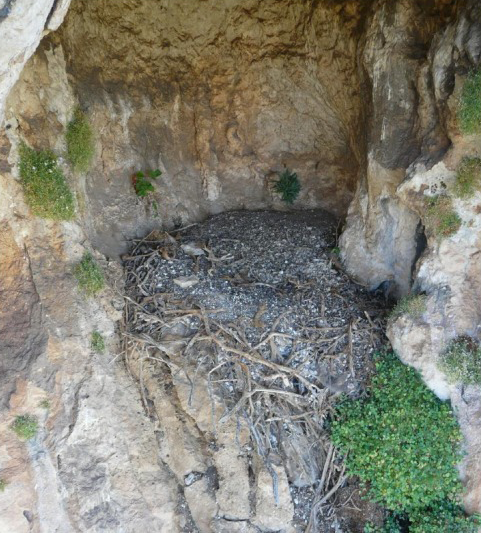
Layers of History
This is an example of a nest site that was analyzed in this study. Bearded Vulture nests are often built in cave-like crevices up high on European mountainsides.
One Layer At A Time
A recent example of this was revealed in a study of Bearded Vultures, a raptor species that nests in sheltered, cave-like crevices on cliffs high up in European mountain ranges. The vultures return to these territories year after year, using those same caves for future broods. Their sheltered nests are protected from most weather, and the cool, dry environment of the caves preserved the quality and the contents of each nest better than scientists could have ever predicted.
The study, conducted in southern Spain, describes how researchers found and analyzed the contents of 12 Bearded Vulture nests. The birds continually build the nest up with a thin layer of additional nesting material each year, which is then somewhat flattened by the chicks as they grow. This back and forth layering of nest materials over the detritus from the previous season’s nesting attempt creates a stratigraphic effect over time. By analyzing and carbon dating items found in these layers, the scientists were able to determine the approximate age of the nests.
Nests of the Ancients
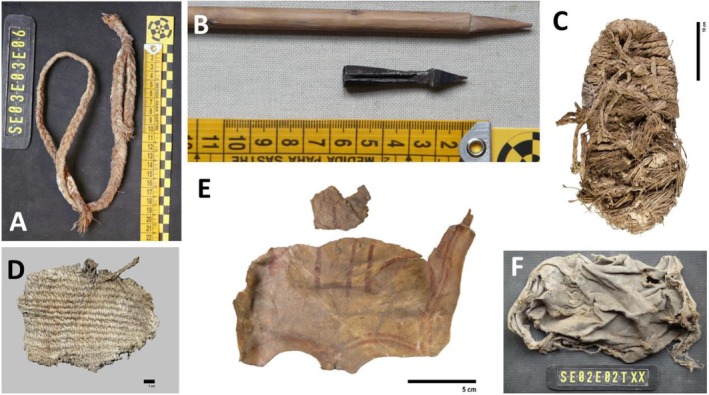
Ancient Artifacts
Materials found in ancient Bearded Vulture nests included, among other items: part of an esparto grass slingshot, a crossbow bolt and its wooden lance, a shoe made of several species of grass and twigs, a fragment of basketry, a piece of sheep leather, and a piece of fabric.
As you might expect of a species that eats bones as a main part of their diet, the nests of Bearded Vultures were littered with bone and eggshell fragments from activity throughout the nesting season. But there were some surprises in the nesting material, too. Several human-made items were found in the nesting material: items made from esparto grass, cloth, leather, a crossbow bolt, and even woven shoes were found in these nests, likely incorporated as the softer interior cup, or in the case of the crossbow bolt, perhaps arriving at the nest along with dead prey.
So, just how old were these nests? Esparto grass has been in use for thousands of years in Spain, Portugal, and Northern Africa, and when these items were carbon-dated, many were indeed found to be hundreds of years old. In a surprising find, the shoe made from woven esparto grass dated back nearly 700 years. It’s incredible to think about how that particular nest had been in use by generations of vultures since the medieval period!
Shockingly, this longevity is not unique to Bearded Vultures. Twigs analyzed from a Golden Eagle nest in western North America indicated that it had been originally built over 500 years ago, and one nest of an Egyptian Vulture, a close cousin of the Bearded, has been documented to be in use for over 115 years. Those are relatively recent when compared to the oldest known nest still currently in use, which is located on a cliff in Greenland. It may have started out as a Common Raven nest, but it’s been reused by both Gyrfalcons and Peregrine Falcons, which often adopt the abandoned nests of other birds. Using carbon dating on the layers of guano that accumulated at the nest site, scientists discovered that this particular nest ledge has been in use for approximately 2,500 years!
This longevity is incredible for a bird nest, representing hundreds of pairs of birds returning to this same location to build upon the nest of their predecessors. Not only does this lend a unique view into the lives of these birds and of the patterns they’ve followed for centuries, but it also provides a fascinating ethnographic and ecological view into history, giving us a glimpse into what the environment and local cultures were like throughout the period the nest was in use.
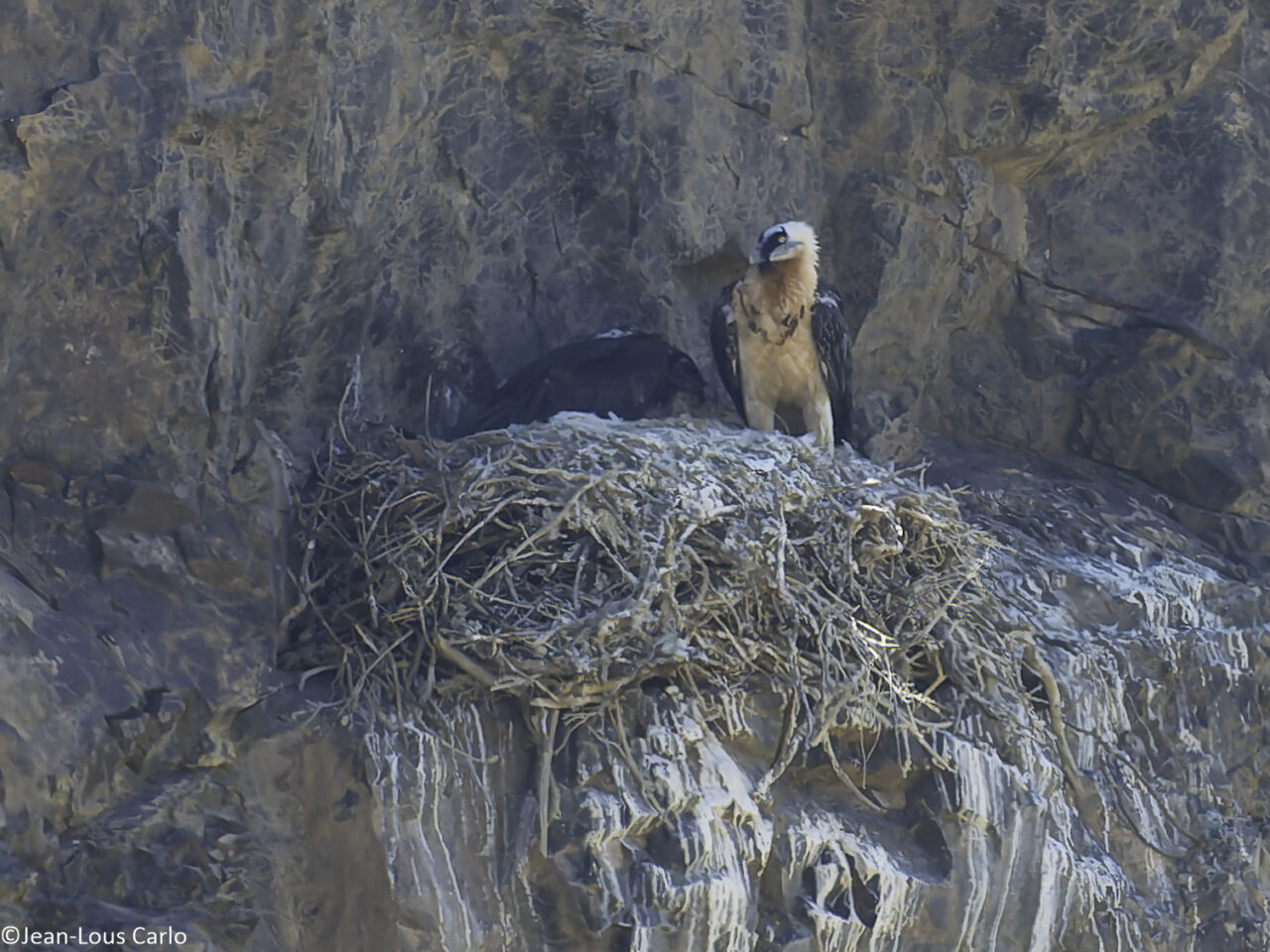
High on a Rocky Ledge
Over the years, nests are built up in layers of sticks and branches alternating with detritus from the nesting season, which often includes food and bone fragments, eggshells, and other items.
Nests As Living Museums
These discoveries indicate the value of such biological “museums” and the ecological role certain places hold. How can we use this new knowledge to frame the future of nest conservation while also preserving our biocultural heritage? We might start by asking, “What is happening to the nests of birds that rely on land that humans consider valuable, too?” and “What historical insights are we missing as these valuable habitats are repurposed for human use?”
The answers are, of course, complicated, but this recent discovery of the Bearded Vulture nests really highlights how important some resources are for nesting birds and why we should protect these special places for generations to come.
The more we learn about old nests, the more we learn about the species as a whole and how to shape conservation initiatives to be most effective. If you have historical nest records (don’t worry, anything within the last century will do!) please consider sharing them with NestWatch to provide a valuable addition to our ever-growing knowledge about the life history of birds. Reach out to NestWatch@cornell.edu with any questions. But please don’t wait 700 years to help us capture this knowledge—the birds need us now!
References:
- Margalida, A., S. Couto, S. O. Pinedo, J. M. Gil‐Sánchez, L. Agudo Pérez, and A. B. Marín‐Arroyo. 2025. The Bearded Vulture as an accumulator of historical remains: Insights for future ecological and biocultural studies. Ecology 106(9):e70191. DOI: 10.1002/ecy.70191
One comment on “Old Nests Reveal Ancient Ecology”
I’ve seen that nest in Western US – in my old home territory. It was active when pioneers started coming through and was active for at least 100 years after that. Haven’t been there for a while. It’s up on a moderate sized cliff in Malheur County,