
Why Are American Kestrels Declining? New Insights from a Continental Study
May 12, 2026By Robyn Bailey, NestWatch Project Leader
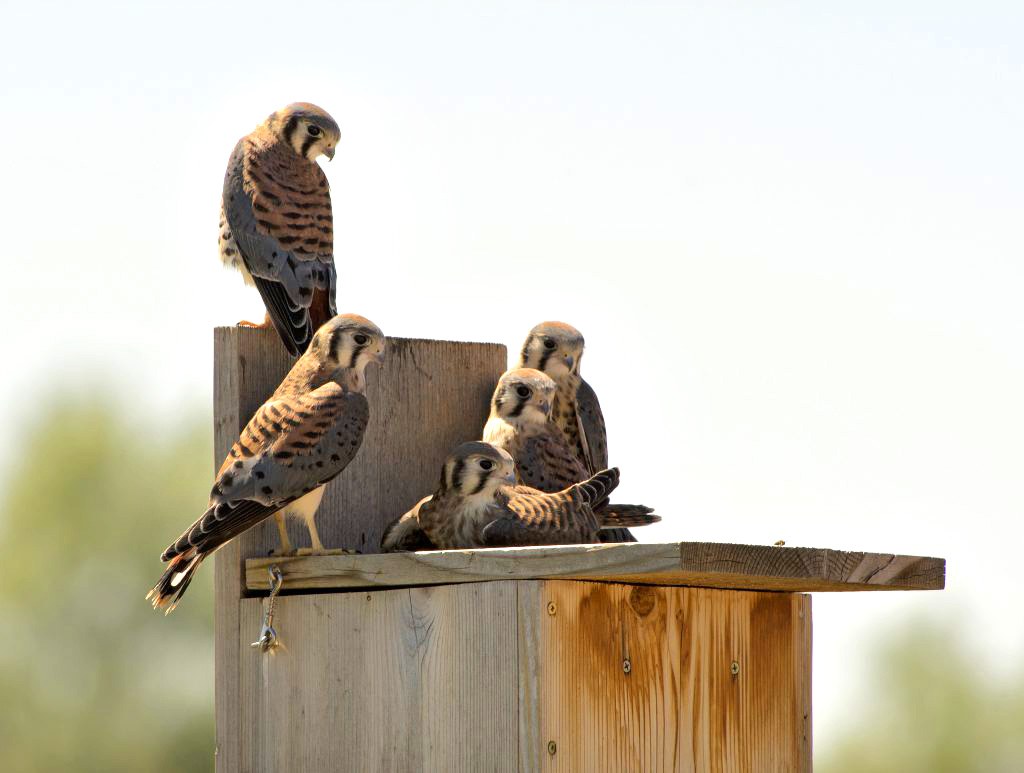
Losing Ground
American Kestrels have been experiencing widespread declines since the mid-1960s.
The American Kestrel is a small, cavity-nesting raptor that breeds from Alaska and Northern Canada to the southern tip of South America. It is one of many grassland-nesting species that share a troubling trend: widespread population declines across North America since the mid-1960s. Although kestrels have been studied more than many other grassland birds, scientists still don’t fully understand the causes of their long-term decline.
From 2022 to 2024, NestWatch participated in a study led by a national working group that brought together numerous long-term datasets on American Kestrels from across the United States and Canada. Many of these data sources were made possible by participatory scientists, including contributors to NestWatch, The Peregrine Fund’s American Kestrel Partnership, Breeding Bird Survey, and those who band birds or report encounters with banded birds. By combining these datasets, researchers were able to examine how demographic factors relate to population trends at a continental scale. The results of this multi-institutional collaboration were recently published in the journal Ecosphere and are publicly available.
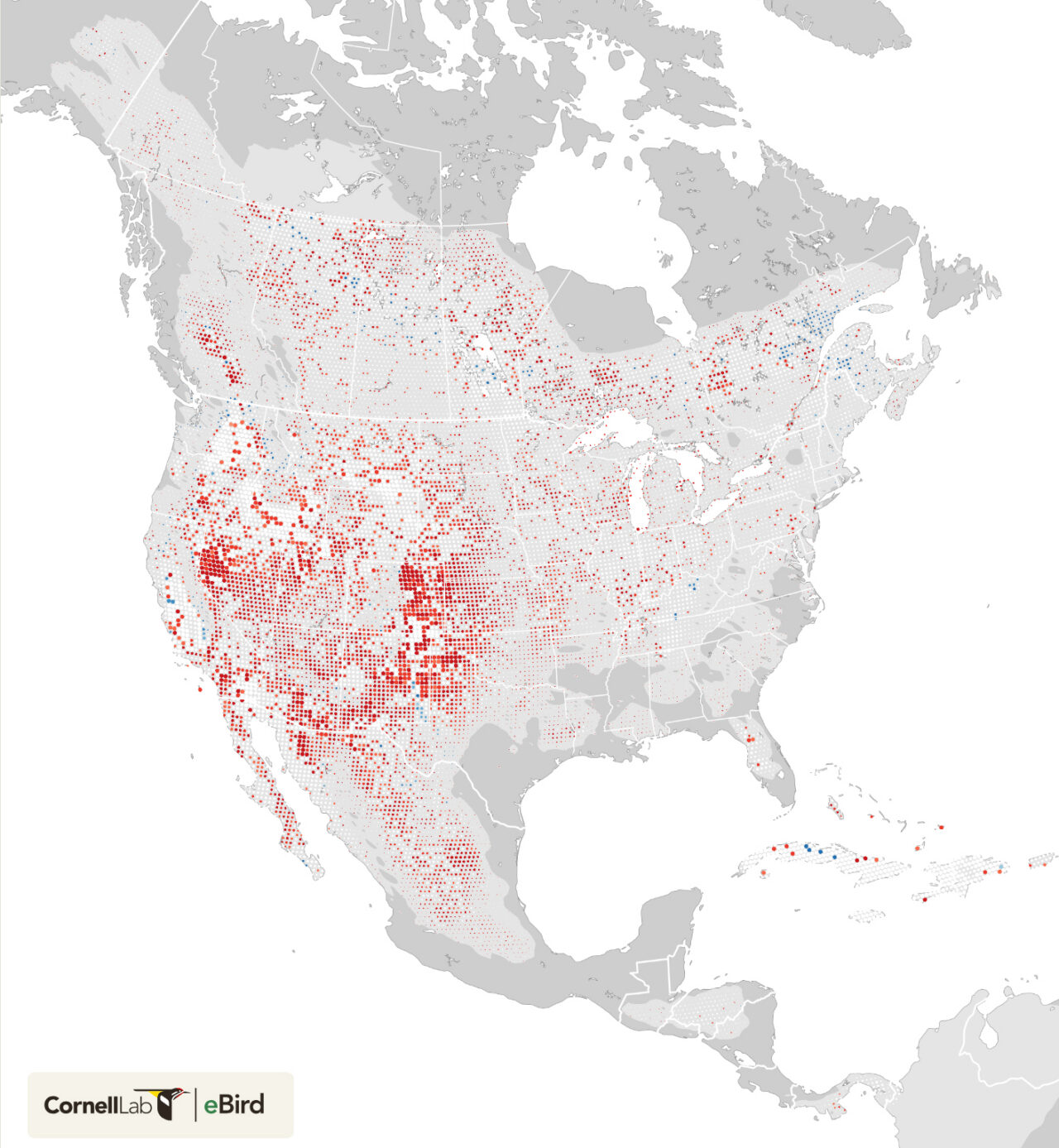
Population Trend Map for the Breeding Season
This map shows the cumulative change in estimated relative abundance from 2012 through 2022. Red dots indicate decline and blue dots indicate increase. The darker the color, the stronger the trend. Explore the interactive map here.
The study found that the American Kestrel population declined by 29% between 1986 and 2019 (Howell et al. 2026). Over these three decades, the average annual brood size—about 2.84 young, including failed nests—did not show a corresponding decline, though it did vary from year to year. Instead, the authors found that adult survival rates had a stronger influence on population growth than breeding-related factors.
What does this mean for improving population trends in American Kestrels? The findings suggest several challenges that cannot be solved by nest box provisioning alone. Factors likely affecting adult and juvenile survival include declines in arthropod prey, the use of rodenticides, exposure to neonicotinoid insecticides, and predation pressure. These results may also shed light on broader patterns affecting other grassland birds that share habitat with kestrels.
People can help kestrels by installing nest boxes in safe, pesticide-free areas and adding predator guards to protect both incubating adults and their young. Reducing or advocating against the use of rodenticides can also benefit kestrels and other raptors by improving survival rates.
We are grateful to the many NestWatch participants who contributed nesting data on American Kestrels, making this study possible.
Reference:
- Howell, P. E., A. J. Lawson, K. P. Davis, G. S. Zimmerman, O. J. Robinson, M. A. Boggie, M. J. Eaton, F. Abadi, J. L. Brown, J. A. Heath, J. A. Smallwood, K. Steenhof, T. Swem, B. W. Rolek, C. J. W. McClure, J.-F. Therrien, K. E. Miller, and B. A. Millsap. 2026. American kestrel population trends and vital rates at the continental scale. Ecosphere 17(2):e70526. https://doi.org/10.1002/ecs2.70526
8 comments on “Why Are American Kestrels Declining? New Insights from a Continental Study”
When I was a teenager I used to see kestrels all the time when I visited The Great Swamp Wildlife Refuge. They would sit on the telephone pole lines going to the visitor center overlooking fields. I don’t know if they are still there as I haven’t been back there in decades.
There is a nesting pair of kestrels not far from me in Cambridge, Maine. They are new to our area and I occasionally drive over just to watch them.
Our experience has been the harassment by blackbirds, magpies and others at nesting locations. We had a long series of successful nesting until the harassment became too great. No nesting for the last several years. So sad.
I witnessed a kestrel trying to claim an old Northern Flicker nest hole but prevented from doing so by Starlings. It made attempts over several days and then gave up and disappeared not to be heard or seen again. The starling threat has been increasing in our lakeside cottage area and its having a devastating effect. Frustratingly so.
I’m very interested in this project. I live near Canton, Georgia and would like to connect with whom ever is collecting the Kestrel data in that area. Is this possible and if so how?
I have had a Kestrel box for over 20 years. We are here on a small farm of about 100 acres of grass land. This is where from time to time I graze cattle. My box is what one might think of as a Wood Duck box. It has about a three inch hole and is mounted about 20 feet in the air on a 4 by 6 vertical pole. Our mating pair usually show up around late March to early April. I am in northern lower Michigan. Here at that time frame we are not completely out of winter. The pair will show up and then a snow storm may come through and scare them off. Most of the time they will be back in a couple of weeks. Over the years I have never cleaned the box out or put any kind of material in the bottom to aid in nesting. I do log there arrivals over the years.
2 questions:
1. How much grassland is needed? I have a forested area, with 2 meadows that I mow once a year. But the meadows are only about 1 acre each. Also, the property was logged about 25 years ago, so there are not very many big trees with cavities. There is some farm ground nearby and a creek.
2. Is there a resource where I can buy a nest box? Or, are there at least plans (dimensions / drawings) of one I could use as a guide?
Hi Susan, We have free downloadable nest box plans available on this website – check out the plans for American Kestrels on this webpage. As for their habitat – according to Birds of the World, their typical breeding habitat is large (>25 hectares) pastures or recently fallowed fields, with a few isolated large dead trees for nesting and several potential perches (trees or utility lines). However, they are also known to nest along powerline rights-of-way bordered by forest, which are much narrower areas. If you have further questions, please feel free to email nestwatch@cornell.edu.