
Why a Hotter Climate Could Mean Fewer Fledglings
November 20, 2026By Holly Grant, NestWatch Project Assistant
Organisms across the world are facing the challenge of adapting to warmer temperatures. Life-sustaining behaviors and processes, like finding food or incubating eggs, function best at certain temperatures. Predicting how these organisms respond to thermal stresses will help researchers to better anticipate their conservation needs.
Most studies of physiological performance have been conducted with cold-blooded animals, whose internal temperature is closely related to the environment, therefore giving scientists a useful way to assess these species’ vulnerability to climate change. But these tools don’t work as well for warm-blooded animals that strive to maintain a constant internal temperature with adaptations like sweating, panting, and shivering.
Developing a Model
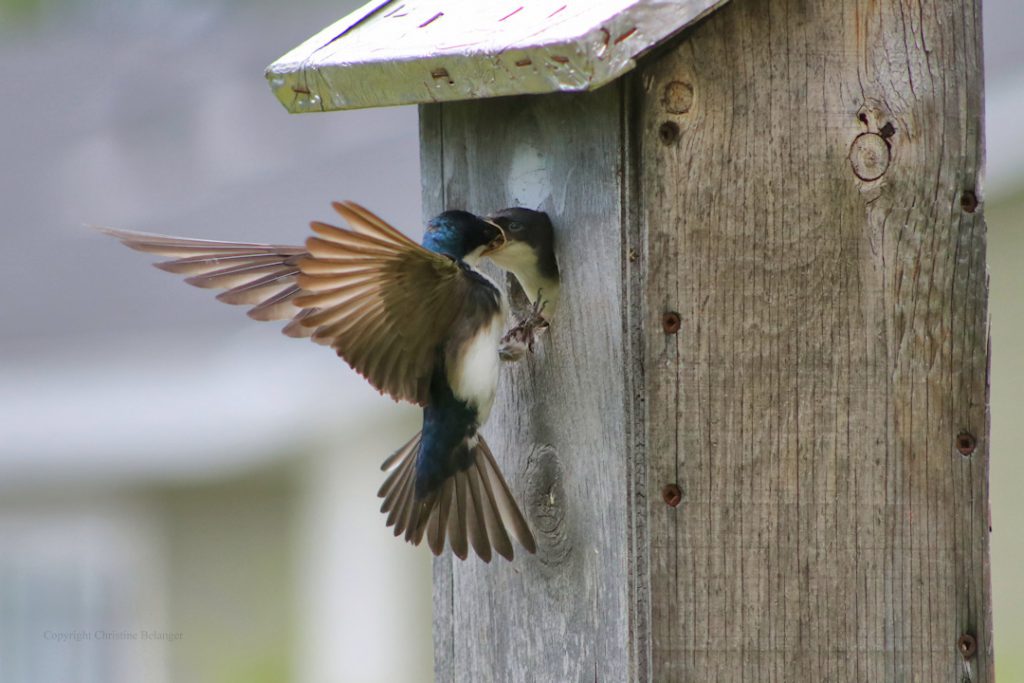
Researchers at Iowa State University sought to develop a model that can help scientists better predict the way climate change may affect warm-blooded animals, like birds. The authors tracked Tree Swallows during the breeding season and found that their provisioning rate (that is, the rate at which they are able to bring food to their young), was highest when thermal stress was lowest (Porter et al., 2026). Meaning, when the birds didn’t have to spend energy on keeping warm or staying cool, they could devote more energy to providing food for their young.
It makes sense that if birds have more energy to devote to finding food, they’ll be more successful at it. But, how might food abundance be affected? Tree Swallows are insectivores, and so eat mainly insects. Usually, the hotter it gets, the more insects are active, so surely the birds should be able to perform just as well during hot weather as long as there is lots of food available, right?
Not quite; the researchers found that provisioning rates declined even more steeply in weather that was warmer than the optimal temperature, even with plentiful prey available. While birds generally have higher body temperatures than humans (Tree Swallows average 107.8 ℉ according to Tapper et al., 2021), there’s a point where it’s just too hot to complete any physical tasks without stress. Imagine how you might feel if you were running a footrace on the hottest day of the year!
Testing the Model with NestWatch Data
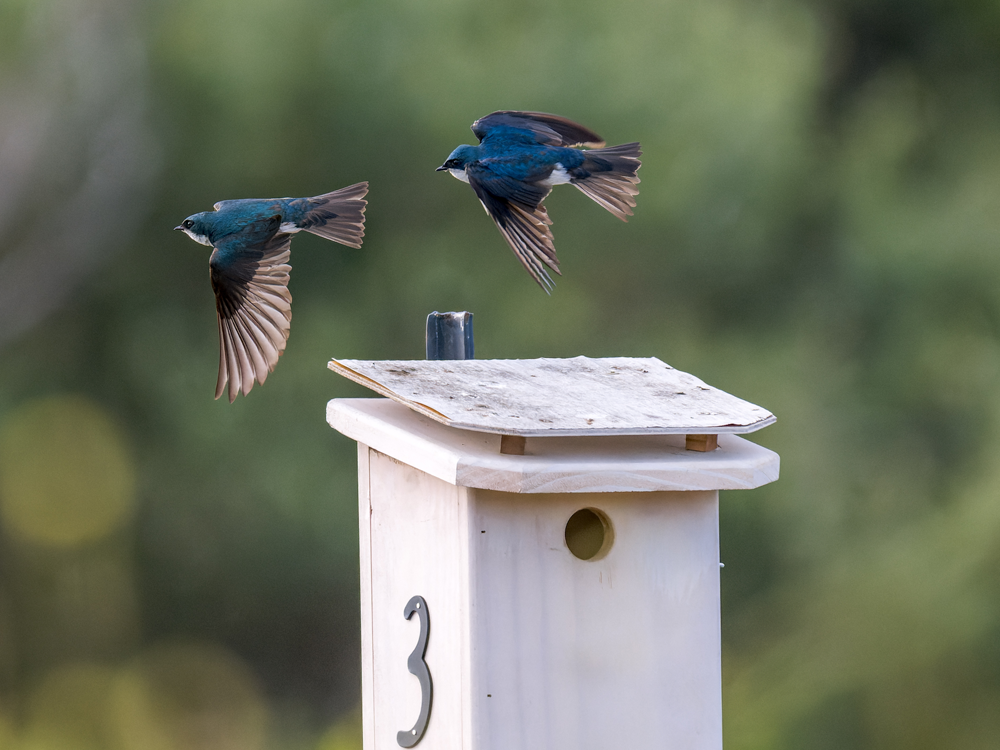
As part of this study, the researchers also looked at 83,484 nest records from NestWatch to determine fledging success across their range. They compared data from areas where Tree Swallows experienced optimal temperatures most of the time, against other areas where there was a wider range of temperatures throughout the breeding season. Nestling growth rate is highest during the early stages of development, and so when temperatures were in the optimal range (meaning provisioning rates were higher) during those early stages, the authors found higher nestling-to-fledgling survival. In other words, they confirmed that the average ambient temperature during the breeding season has a direct effect on nest success.
The researchers tested their model with nine other common species that have widespread ranges and found that it could be used to predict breeding range fairly accurately for all of them.
Range Rollback
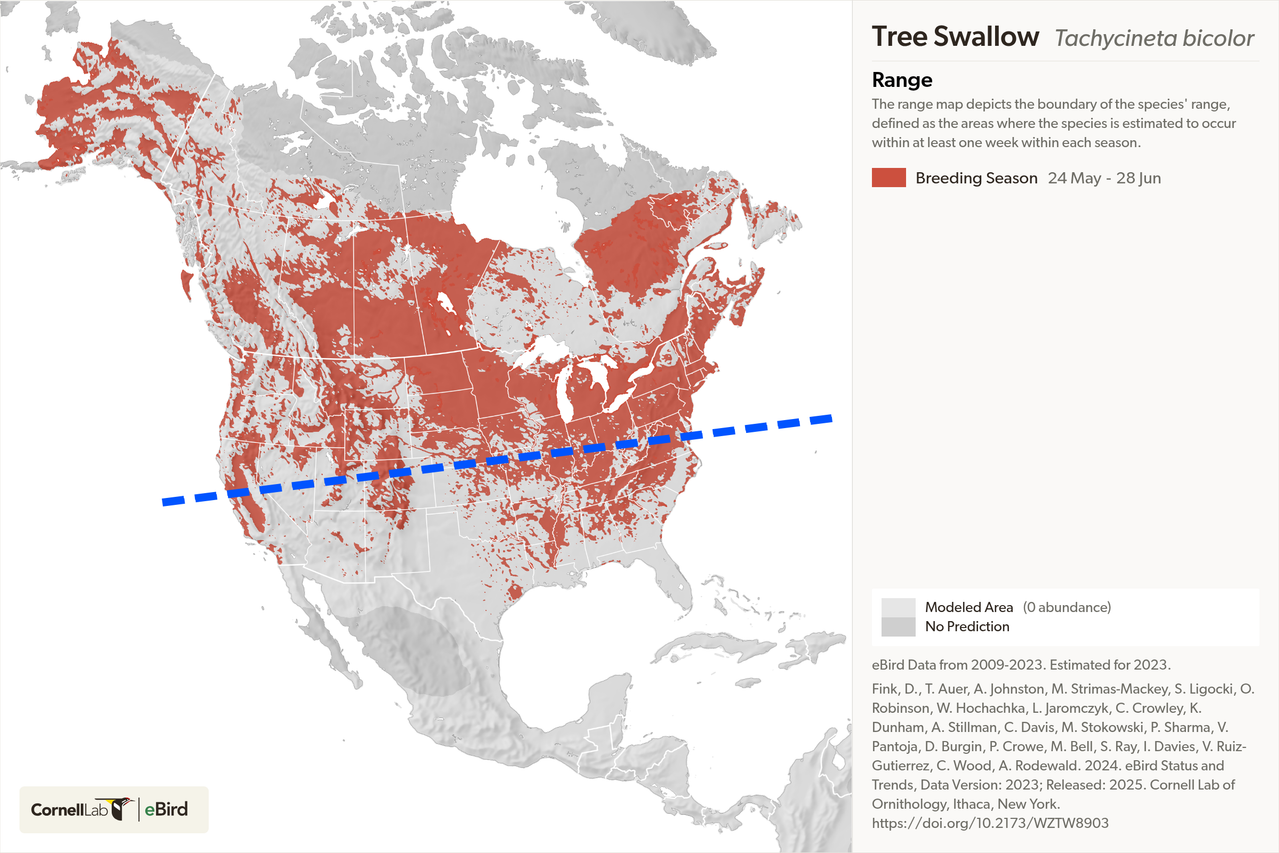
So, how does this model help us with conservation? It’s well known that cold snaps in the spring lower chick survival through thermal stress and a reduction of prey availability (Shipley et al., 2020), and Tree Swallows are declining over much of their range. Despite this decline, they have simultaneously expanded their range southward in recent years. However, in a warming climate, the model predicts that the southern limit of the breeding range for Tree Swallows may shift northward as much as 6.3 to 9.8 degrees in latitude (about 700–1,100 km), depending on the climate scenario. In a worst-case scenario, the authors added that Tree Swallows might need to shift their peak breeding one month earlier to make sure they are feeding young in their nests when environmental temperatures are optimal.
Data from Common Species is Always Valuable
These models are critical for conservation because they can help predict the way population movement might happen as the climate shifts, and why. In this case, it was not necessarily lack of prey that impacted Tree Swallows the most, but rather their ability to gather it under heat-stressing conditions. They show us several possible outcomes, so the better we can prepare for these changes, the better resources can be spent on how to respond with new policies and protections.
Your contributions to NestWatch helped make this study possible! By analyzing nest data from our database, the researchers were able to quickly compare the success of >80,000 nests against current climate patterns to determine how nest success relates to environmental temperatures. Thank you to all NestWatchers. Your data—even about the most common species—are critical to conservation research!
References:
- Porter, C. K., D. R. Adams, O. Levy, N. Urinovsky, and E. A. Riddell. 2026. Thermal imbalance drives avian performance and responses to climate warming. Proceedings of the National Academy of Sciences of the United States of America 123:e2630333123. https://doi.org/10.1073/pnas.2630333123
- Shipley, J. R., C. W. Twining, C. C. Taff, M. N. Vitousek, A. Flack, and D. W. Winkler. 2020. Birds advancing lay dates with warming springs face greater risk of chick mortality. Proceedings of the National Academy of Sciences of the United States of America 117:25590-25594. https://doi.org/10.1073/pnas.2009864117
- Tapper, S., J. J. Nocera, and G. Burness. 2021. Body temperature is a repeatable trait in a free-ranging passerine bird. Journal of Experimental Biology 224:jeb243057. https://doi.org/10.1242/jeb.243057